On the Origins of Twistor Theory by Roger Penrose
Monday, December 6, 2010
Friday, December 3, 2010
Atom Nucleus
Here is a link to an overview of the Grand Orbital Table
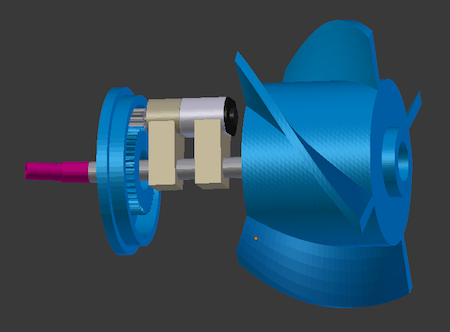
A contra-rotating propeller will have no rotational air flow, pushing a maximum amount of air uniformly through the propeller disk, resulting in high performance and low induced energy loss. It also serves to counter the asymmetrical torque effect of a conventional propeller. (wiki link)
Thursday, December 2, 2010
Circulation, Stabilisation and Polarisation
The torus-current (blue) generated within the trefoil knot (gray) is opposite to the outside of the trefoil knot's rotation, these opposite rotations, clockwise and counter clockwise (white arrows) stabilise the whole current system. In the center an extra vertical, upwards current (red) is generated because the rotation/flow of the torus and the trefoil knot are at that place the same. This gives rise to an sphere that has a polarised, north -> south, outer flow with a suction power (+). This way an atom would be like a fountain with a B-side, where one side spray's out the parts that make up an electron, and a fip-side that sucks 'm back up at the other site.
Wednesday, December 1, 2010
Vortex Rings & Bernoulli's principle
Who knows an electron might be a vortex or a particle cloud, that moves from the inside out, through the core of the proton, and round and round, along with the current generated by the spinning inner torus, based on Bernoulli's principle and the Magnus effect.
... and an electric-current might be the event of shooting electrons from one atom to an other, if the movement within vortex is a spiraling flow, the formation might even wind up like an (8).
Water
Smoke
In fluid dynamics, Bernoulli's principle states that for an inviscid flow, an increase in the speed of the fluid occurs simultaneously with a decrease in pressure or a decrease in the fluid's potential energy.
The Magnus effect is the phenomenon whereby a spinning object flying in a fluid creates a whirlpool of fluid around itself, and experiences a force perpendicular to the line of motion.
Monday, November 29, 2010
Proton - Trefoil-knot - Torus - Tornado
A Trefoil-knot, build up out of a spiraling closed circuit, would have an infinite internal flow, in a medium where there are no other forces other than density. The three 'loops' of the knot can be seen as the blades of one propellor, that rotate around the center axis, and that has a passage in the middle. This formation generates a torus like current that spirals and flows through each individual loop. Such a running Torus in combination with the propellor motion of the blades/loops, works like a turbine that sucks matter through it's core. A tornado that generates a positive charge (+).
The loops of the Trefoil-knot might also work as a tripod, keeping the whole thing 'grounded' and in balance, this in contrast to a 'stand alone' Torus with an inner spiraling flow. Such an object would start spinning in all directions, being unstable, and having eventually no real suction power, zero charge (0), or perhaps a Torus on its own might be a Lepton. See short clip below, of the rotating optical illusion.
Sunday, November 28, 2010
Force & Energy
The cube (x^3) on the left stands for a vertical and horizontal expansion,
the rectangle on the right stands for only a horizontal expansion (x^2).
Force or energy is going with or against the flow, pushing or pulling, driving along or against, accelerating or slowing down, it all depends from which point you obseve the interaction. Force originates from one, or multiple points that work together and can be seen as one.
For F=ma^2 (note: I have taken here the wrong formula, I meant Galileo's simple "Distance=time^2") the force increases over time within a square during which an object is attracted (falls). If we look at the (8) as a formation that propagates with each axial turn, an equal forward propagation, like the 'pitch' of a bolt (fastener). When we imagine an emitted stream of these 8's, that screw matter towards its origin, than we see that there is only a horizontal wave interaction between parallel streams, with each rotary spin of the 'blades', while there is no force acted on a (8)-particles in-front or behind. If there was an a force in a vertical up or down direction, there would be a cubic forcefield, and particles could not be emitted, also Galileo's law would have been Distance=time^3 (F=ma^3).
If we look at the falling apple, it accelerates because the force-field-density, of streams of 8's increases, every time the apple is screwed downwards, by these emmited spiralling streams of 8's, that move upward (pitch) away from gravity source.
For E=mc^2 the starting point is light itself, 1 rotational cycle of an 8-particle and its perpendicular wave (((8))), generates a pitch that is equal to 1 forward movement oo -> oo. The speed of the (8) is constant because of the infinite cyclic inner-movement, it is a closed-circuit-helix-like-formation that is driven by it's own inner spiraling domino effect.
Energy increases each time the mass (formation or volume) of an object increases within the Aether, generating more emission power because of its friction, 8-bubbles generating behavior. The Energy increases in the same way gravitational force works because vertically the 8-bubbles follow each other, with equal speed, and the way they slipstream (draft), moving away from the 8-bubbles-generating-source, the area covered becomes topographically larger at the same rate the volume or mass becomes bigger.
If we look at atomic fission or fusion, Energy is generated because the total volume is redivided at the lowest level generating an bubble-interaction-fest that has an expansion speed that is enormous due to origin size and density.
Note: The period, T s, of a pendulum swing (length l m) in a region of acceleration due to gravity, g ms^-2, is independent of the mass of the bob. T = 2π(l/g)^1/2 as Galileo observed.
T (seconds) = 2π (dimensionless) x square root of (l (metres) divided by g (metres per second^2))The square root of something of dimension second^2 has dimension seconds.
Friday, November 26, 2010
Particle Collisions (interaction)
During Particle collisions all kinds of interactions happen, spiraling Proton-knots are cut into different pieces, or entangle together and snap as they twist and turn in different directions generating spirals that maintain their formation (8), or spirals that unwind (Jet).
Thursday, November 25, 2010
No Aether! An over reaction?
Ever since the Michelson-Morley Experiment it is presumed that there is No Aether! Is this an overreaction to the failure of not discovering Aether-Wind?
Take for instance one of those asian hot air balloons made out of paper, that are lifted up in the air during festivals, one can ask why doesn't the wind blow out the flame and set the framework to fire? It's because the balloon travels along with the wind at the same speed, so every part of the unit travels within the same space and time frame.
If you look at the set up of the Michelson-Morley Experiment it uses two 'banks' how can this ever been taken as a reference, two solid standing banks while the Aether just flows by? Aren't the mirrors and detectors going along with the flow, just like all the parts of the hot air balloon? (Here is an animation of the MME where it's possible to adjust the settings)
I believe that science at that time was in 'a high' for finding the constant speed of light, but when the experimental search for Aether Wind didn't gave the result they expected, the revolutionaries boldly threw out the whole Aether concept. An other factor were Einstein's theories, where light can be seen as a constant to define space, it reduced the mathematical need for an Aether, but that doesn't mean that we no longer should take it in account.
Aether why? Because it simply has to be. How can a proton attract an electron if there is no medium through which forces are transmitted? There is only one type of current generator, and that is the action of compressing and decompressing mater, be it wind or aether, generating suction or a blowing things forward, affecting it's surroundings by pulling or pushing things to or from the generator. In a flow the interaction can speeds up of slowing things down, both can be seen as a negative (-) or a positive (+) force.
Take for instance a look at the classical fan, or the more modern Dyson Air Multiplier Fan, these turbines both suck and blow wind. btw note that the Dyson actually also has a propeller (8) inside.
Take for instance one of those asian hot air balloons made out of paper, that are lifted up in the air during festivals, one can ask why doesn't the wind blow out the flame and set the framework to fire? It's because the balloon travels along with the wind at the same speed, so every part of the unit travels within the same space and time frame.
If you look at the set up of the Michelson-Morley Experiment it uses two 'banks' how can this ever been taken as a reference, two solid standing banks while the Aether just flows by? Aren't the mirrors and detectors going along with the flow, just like all the parts of the hot air balloon? (Here is an animation of the MME where it's possible to adjust the settings)
Aether why? Because it simply has to be. How can a proton attract an electron if there is no medium through which forces are transmitted? There is only one type of current generator, and that is the action of compressing and decompressing mater, be it wind or aether, generating suction or a blowing things forward, affecting it's surroundings by pulling or pushing things to or from the generator. In a flow the interaction can speeds up of slowing things down, both can be seen as a negative (-) or a positive (+) force.
Take for instance a look at the classical fan, or the more modern Dyson Air Multiplier Fan, these turbines both suck and blow wind. btw note that the Dyson actually also has a propeller (8) inside.
p.s. There are also some more serious people considering Ether, check National Geographic's article: Dark Matter's Rival: Ether Theory Challenges "Invisible Mass"
Tuesday, November 23, 2010
Subscribe to:
Posts (Atom)