Wednesday, June 8, 2011

Curves


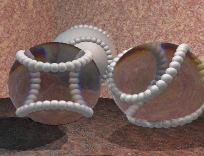
The Curvish structure of the 8 has a lot away of the stitching of a Baseball or the lines on a Tennisball. In mathematics this curve falls roughly in the section of "Constant Curvature Curves" one can find a lot of information on this curve on the website of professor Palais et al and their program 3D-XplorMath that can be downloade for free at http://3D-XplorMath.org/index.html. The image below is made with this program and there is even the possibility to view it in 3D if you have a pair anaglyph glasses. http://virtualmathmuseum.org/SpaceCurves/constant_curvature/constant_curvature.html


Daren Scot Wilson on how he contructed the seam on a baseball


Winston Mitchell made the loop like I did, by using half circles


 Paul Bourke


Tuesday, May 17, 2011

Boid Interaction Flow Chart


A rough flow chart setup of how a boid-interaction-system might be defined for particle interactions. 

Downloadable: flow_chart_800.pdf (115k) - FlowChart_guide.pdf (37k)

Friday, May 13, 2011

Magnetism


When electrons are attracted through vibrations of the positive suction power of protons in the nucleus of an atom, they start to generate a current-train of electrons, that spirals round the outside of the electric wires, towards their target.


While storming through the Aether the electrons compress at their centers, the relative free particles, that make up the Aether, stamping them into a new unity of jointed particles. A smoke rings production like process. These new particles have their own properties such as, forward movement and spin. Once formed, the emitted particles spiral away from the source (wire) and generate an electric field that surrounds the conductor.


When a coil is made and a current generated within, the puffed out particles that spiral away, collide with particles that are coming from opposite directions, due to the construction.


Because of a continuous inflow of puffed-out particles, a compression area between the wind-up wires is generated. It is here that pairs of opposite particles (light- & dark green) are pushed into each other. They entangle, break and melt into a new harmonious particles. These new particle have the shape of an 8 and start to spiral upward. It are Force particles transforming the coil into a magnet.


A smoke ring generator (zerotoys)


Additionally, the crystal structure of Magnetite has a similar a tight lined up pattern.


Note: I'm doubtful that the above concept of two opposite O-ring particles fusing into one 8 particle has any merit. But I'm leaving it in, because the puff-particles that are produced when an electron jumps from atom to atom, might be an interesting idea as they could cause some sort of helix / drag circuit by themselves. 

Friday, April 29, 2011

Matter - Anti - Matter


When small spinning toruses combine and form a pile that twists, bends and eventually bites its tail to form a new larger Torus, than the direction of the curls can go in two directions in relation to the rotation of the base structure; Clock-Wise (CW) or Anti-Clock-Wise (ACW). This function is an addition to the 4  movement that come into play:

a. The individual toruses spin around their axis.
b. The group (basis) rotates around its axis, a small shift generates the twists CW or ACW.
c. The newly generated Torus, spins around its axis in CW or ACW direction.
d. The torus winds and crawls forward thanks to the bindings.


When comparing the CW and ACW motion this is where the formation can become an electron (-) or a positron (+) Matter or Anti-Matter.


Z

Annihilation


Annihilation is defined as "total destruction" or "complete obliteration" of an object; having its root in the Latin nihil (nothing). A literal translation is "to make into nothing". wiki

When an electron (e-) and a positron (e+) meet they unwind each other due to opposite twist-directions. Once un-winded the different parts can recombine in all kinds of different complimentary particle pairs.

Thursday, April 21, 2011

Twisting (Winding Up)


When taking the previous starting point of a torus generated out of a pile of toruses (Twisted-Torus-Rotor), we can see that when we have a small shift change that we get a twisted structure of winded-up coils. This way of winding-up entangles the different strings (piles) into one tight Toroid.

A 'twist' in the line forms a 'helix', and each helix acts as a propeller generating thrust and giving the torus the ability of converting rotational motion into forward motion, making it move through the Aether.

The more energy we apply by accelerating the Toroid, the more tight (compressed) it can get and the higher amount of twist it has -> more trust -> a more energetic particle body.

If the object is slowed down during particle collisions, than the number of twist can go down even to the point that one string is untied, detaching itself (shaken loose) from the Toroidal Group and curling itself up to its ground state, forming a new unique particle, and jetting away.

Thursday, April 14, 2011

Tuesday, April 12, 2011

Monday, April 11, 2011

Twisted Torus Rotor

A tryout of a 'twisted torus rotor' setup based on a previous post Synchronous Rotation Motion.


(Sreencast - 20Mb)