Thursday, December 16, 2010

Synchronous Rotation Motion

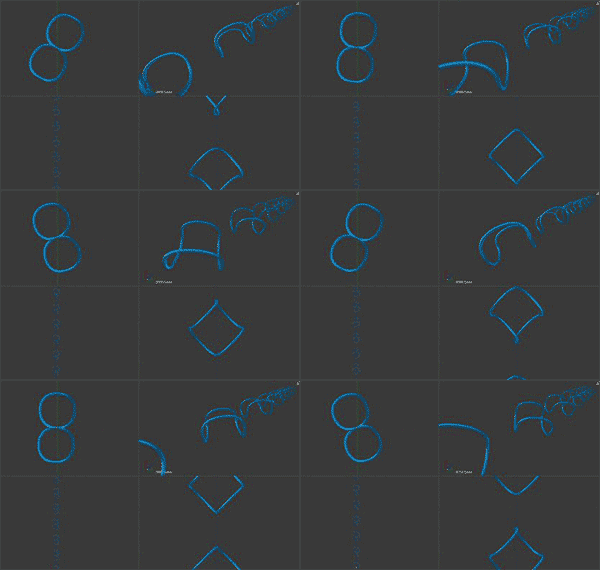
Rotation properties in a sea of particles, will produce spiral structures, similarly to how an O-ring, in a sea of particles, will start to produce patterns.

Sphere-like particles within a pressurised environment, can rotate synchronous with each other when they rotate in opposite directions, or in the same direction, when they are behind each other and closely aligned. They need to be in even numbers to keep the flow going. The most basic formation they can form is in a square, made up of 4 particles. If you have one particle that is the driving force (8) than two squared formations can be formed, one on the right and one on the left side. This setting leaves a gap at the bottom and top, where there is are particles that can not fit in, because in-between spacing is to large, and when it wants to join in, a triplet is formed causing friction so the particles (red) bounce loosely in-between without having the chance to attach itself. This is a Basic law out of which vertex spirals are born, because new particle-formations can attach themselves on, or slipstream behind, the exterior particles of the formation (green) while the red ones keeps pushing the stream outwards.

Tuesday, December 14, 2010

Aether Complexity and Foam

One thing leads to another … if you want to research a universe based in Aether, and where the basic building blocks are: Points (.), Toruses-knots (o),  Lemniscate rings (8) and Trefoil-knots (-<), and where there is basic interaction, than you'll quickly end up with a complex structure of layer upon layer, similar to the Mandelbrot set, where you can zoom-in and discover new structures that interact, forming a network that makes everything tick in it's own relative framework, and you will find out that Aether is like a jungle.

Let's give it a try,  for a structured universe, the points that make up the Aether need to have a starting point that has some potential. The easiest way to create such a potential is a pressed together group of points that creates a gateway or simply put a ring: O. Now let's do a thought-experimentwhat and see what kind of actions a 'hoop' could activate in a sea of points. First of all some points will pass through the 'O', while others cannot, this creates the first pressurised situation and a potential difference, a current will develop going from A -o-> B. By having this potential the 'O' will generate a sphere like current around it's self, with a magnitude that is in relation to the opening, the thickness of the 'hoop', the thickness of the particles and the density of the particles.

If we take in account that the collisions between points are elastic and the 'O' maintains it solid structure than eventually, due to turbulence differences, motion flows patterns will be generated by the particles that are pushed through the 'O' and acceleration. The only possible way these patterns can sustain there motion is when particles slipstream behind each other making infinite close looping. This can only happen when they are in close contact and spin at the same frequency, having the same vertex motion. For this infinite looping motion to happen, there are probably only 3 possible compositions that have the symmetry and the structure to do so without losing energy:
a. Spiraling Torus: (O)
b. Twisted Spiraling Torus: (8) (♢) (oo)
c. Trefoil-knot: (-<)

So let's have a first roundup, a, O-ring in a bath of particles starts to duplicate itself and generate basic knots.


Once these basic formations are produced, we can go to the next level and see how they behave, and what kind of structures this set can produce, alone or by interaction:
  • The Spiraling Torus will do the same as its Originator, having a potential and generate a spherical current around it's core, but due to the fact that it has a spiraling structure, the whole thing will have a rotational spin round it's axis, and has the ability to screw it's way through a medium. Because of it's round shape, it will have the tendency, when moving forward like a ring-cloud to spin clock- or counter clock wise depending on your viewpoint. And due to it's spin, it will also have a vibration frequency like just anything that turns in a medium of point like particles.
  •  The (8), this structure in combination with it's spiraling current, has the property that it will start to screw it's way through the medium in a straight linear way, in a sharp and bold manner, while being in full balance, having the properties of a propellor.
  •  The trefoil-knot, this shape generates an inner-Torus-current that is inverse with the motion of the Propellor rotation of the Spiral. Due to this combination of opposite currents, the whole is stationary in a pool of point particles, having a global spin etc.
Now let's look at interaction: The basic Torus-ring particles have a current running through their middle, if they line up above one another, they cold create a pile, but because of of their spin, the pile will start to bend over after a certain number, 3 things might happen depending on curvature and length:
  1. Toruses form a circle torus or an (8) formation.
  2. The piles bend towards each other and generating a large foam-like structure.
  3. They organize themselves in a horizontal way, generating a flat vertex organization where each member hooks up to the system, and adds it's energy to the whole. A relative giant disk-shaped spiral is formed. These slowly moving disks could collide with one and other, or they could get caught up in the draft of a predecessor and start to form a linear formation, and eventually also start to form new formations such as in case 1-2-3
Lets summarise the structures that we have:
  • Point particle: .
  • Start-off structure: O
  • Spiraling Torus: (o)
  • Spiraling Eight: (8)
  • Spiraling Trefoil knot: (-<)
  • Static Foam
Once we have these basic parts and interactions we can try to see they all start to interact at a more global scale, Like an ocean and an island where at the shores the sea comes in contact with the solid ground of the island. At the shores, two things happen during interaction, waves start to break and foam is generated.

When the sea is more energetic, breaking waves that curl appear, in the same way that would-curls are created when us use a plane to smooth a wooden surface. In a world where there is no gravity, these curls would spin up into the air and keep on rolling like the hot damp of a bowl of soup.


If we look down at the Aether-level of things, where a basic formation such as the (-<) rolls through a sea of point-like-particles, the friction of these objects and it's surrounding particle flow, with it will generate new basic shapes such as the (o)'s, (8)'s and (-<)'s. It is a production area of particles just like when we used a simple 'O' to start of things.  Anyway, only an (8)-knot has the structure to propel straight away from the 'coast line', escaping the setting at a high constant speed.


This shape (8) will also generate a backward gravitational push in the direction of it's origin, all the other particles will start to form foam. At a beach the foam dissolves over time, but at Aether level, the foam maintains it's structure and can grow. In a size and formation that prevents it from collapsing under it's own weight.


This leads us to the situation where we have a (-<) surrounded by a foam and that that connects like a break wave and through which point-like particles roam and where there is friction (8) shaped 'curled up waves' can escape, generating a gravitational force, that also attaches the foam to the (-<), does every particle creates and foamish ecosystem around itself that emits gravity particles (8).


As long the (-<) has it's suction power and a grid around itself that let's mostly everything through like a fishnet, it will keep on attract everything around due to the gravity particles (8), and it will keep on generating a current (+) due to it's global formation. Only another particle that is big enough to temper the suction can neutralize the (-<) This brings us to the combination of (o) and (-<). The (8) has a to high linear speed to be caught only in combination with an (O) will the (-<) have enough swing power to add it to the structure.

When the (-<) has cached an (o) it will hover around and throughout the (-<) keeping the whole thing in balance, just like a dance-couple where the lead swing it's partner around, while moving around. An second option is that the (-<) might catch as well an other (-<) and start forming groups, with multiple (o)'s and these might than again start to interact with other groups creating new structures.

A dancing (-<) and (o) combination will cause in the point-particle sea and foam a wave frequency, but if the motion is to strong, breaking waves could occur and a relative large (8) might break away, with a relative high constant speed, once the excessive (8) is emitted, the couple will have again a stable flow. The (8) that shoot's away will rip through the foam like a knife through butter causing it to propagate waves, but the foam will reform instantaneously.


When there is very little vibration in the grid, single ((o-<)) couples could get real close and start to become tightly aligned. To do so each couple as to loose most of its motion/vibration and when this happens spiral becomes minimal and the inner-Torus current could fade away, the bigger sphere-like property will disappears and the ((o-<)) couples can be stacked. Thanks to the tripod stacking capabilities (>=<) These piles of (o-<)'s can generate one giant current with a larger foam made out of smaller foam, letting the whole area within it's roam rotate. Similar surrounding structures with the same structure solidity and thus range, will attach them selves and make one giant plate (galaxy). These plates can move towards other similar structures or that draft behind others forming a giant foam-like structure called the Universe.


Monday, December 13, 2010

Vortex & Knot Theory

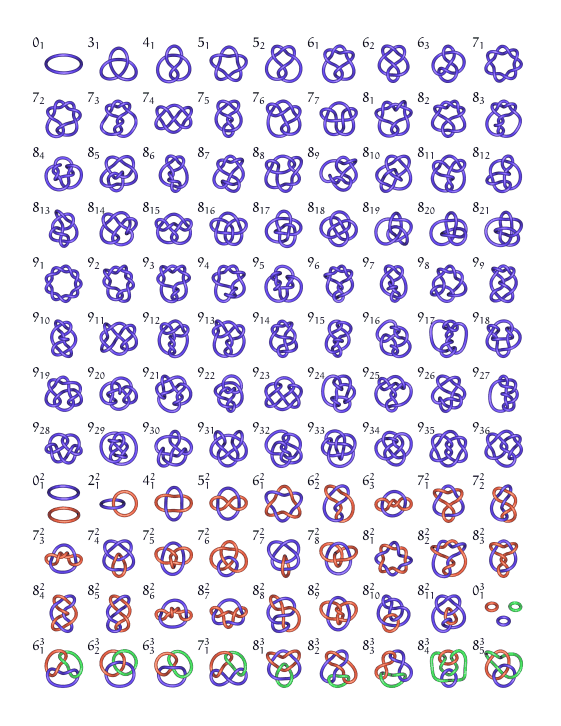
I mentioned in a previous post (History : Old Crackpots and Modern Mathematicians) that during James Maxwell's time (1831-1879) Vortex-theories such as by Sir William Thomson (Lord Kelvin) were popular and widely accepted. Vortex theory was combined by the mathematical Knot Theory.

"In 1867 after observing Scottish physicist Peter Tait's experiments involving smoke rings, Thomson came to the idea that atoms were knots of swirling vortices in the æther. Chemical elements would thus correspond to knots and links. Tait's experiments were inspired by a paper of Helmholtz's on vortex-rings in incompressible fluids. Thomson and Tait believed that an understanding and classification of all possible knots would explain why atoms absorb and emit light at only the discrete wavelengths that they do. " (http://en.wikipedia.org/wiki/History_of_knot_theory)


Knot & Vortex theories were aligned with Aether theories, and the difficulty was how to add values to calculations when you don't know what it is and how it behaves, you need to be able to measure it. Multiple Aether theories existed but not one was applicable for all the different laws of nature, and opposition would arise.

In 1887 a first blow came when the Michelson–Morley experiment failed to provide any measurements of Aether wind. A second blow came in 1900 when Max Planck postulated, that electromagnetic energy could be emitted only in quantized form, Einstein took a look at this fact, and turned light that was originally thought of as only a wave, into a particle (photon) that could move through a vacuum. A final blow came in 1905 when Einstein (again), published his papers on Special Relativity, using light as a constant, and postulating that space can change. The unique fact of this way of looking at things is that he could measure all of the physically observable consequences of Lorentz ether theory (the most advanced Aether theory of that time), without the need to postulate an unobservable entity (Aether). This revolutionized science because it made things easy and modern. As of then Aether was seen as a pagan thing and defenders were boohooed, but perhaps this revolution might have thrown out the baby with the bathwater, being Vortex & Knot Theory, and of course Aether itself.

Edit: The scientific community has drifted away from the idea of a medium (aether), and considered it wrong, but when looking at the history of physics you might want to think again. Albert Einstein writes in the end of his book - Über die spezielle und die allgemeine Relativitätstheorie (link) -  that his theory does not contradict the theory of an Aether at rest:

"Betreffend den Versuch von Michelson und Morley zeigte H. A. Lorentz, daß dessen Ergebnis wenigstens nicht im Widerspruch sei mit der Theorie des ruhenden Äthers."

While some like to focus on the 'Michelson-Morley experiment':

"Its results are generally considered to be the first strong evidence against the theory of a luminiferous aether and in favor of special relativity (SR). The most immediate effect at the time was to put an end to Lord Kelvin's Vortex theory, which said that atoms were vortices in the aether." (http://en.wikipedia.org/wiki/Michelson–Morley_experiment)

The difference in the 2 statements is; in the first Einstein focusses on the fact that SR is not against Aether, while the second focusses on the fact that SR is against Aether. The difference is Aether at rest vs. luminiferous Aether.

-

At the center of my knot-model there is a Trefoil-knot (Proton) with 3 Loops (Quarks), connected via a string to the Torus (Electron), all rotating and moving through a Dynamic Foam (SpaceTime).


Large interconnected-structures form heavier Atoms with Shells.


A figure 8 Knot (Photon) is like a helicopter, 
shooting from Torus (Electron) to Torus (Electron):  O = OO => O


Check the top-view where the rotating ((8)) is like a torpedo with propellor shooting forward, or at side-view where it is like a stingray steadily swimming forward.


In essence this idea of having knots emerge within a medium is at the opposite side of the Millennium Run. They zoom-out towards the large networks, while I'm zooming into the foam-ish Aether wherein small self-regulating networks and knots emerge.


Electron - Toroidal

As always you are never alone, recently I've been discovering similar ideas to mine, here is a paper by J.G. Williamson and M.B van der Mark: Is the electron a photon with toroidal topology? 

"The primary reason that the electron is considered to be elementary is that experimentally it appears to be point-like and hence structureless. At the same time we are confronted with the fact that it has a rich set of properties which are fundamental to its nature. It has an elementary charge, a half-integral spin, a definite mass, a well de ned dipole moment, an anomalous spin factor g-2 and of course a wave-particle nature. It seems inappropriate to think about such things as the elementary charge as a separate building block from the elementary particle which carries it. A deeper understanding requires a unification of the aspects discussed above in terms of an underlying principle." (pdf)

Spiraling closed infinite loops: the (8) and a double loop trivial knot that also resembles to a trefoil-knot and its Torus

Saturday, December 11, 2010

Soliton - Solenoid

Play of words part II, in mathematics and physics, a soliton is a self-reinforcing solitary wave (a wave packet or pulse) that maintains its shape while it travels at constant speed. If you see the trefoil knot as a particle structure trough wich this pulse propagtes ... A solenoid is a bunch of coils, if you look at the trefoil knot it is a structure made up out of 3 coils. If in a solenoid a current is generated, an electromagnetic field is generated, and there we have our Torus-current in a toroidal coil, generating a charge (+).

Toroidal coil with multiple loops, generating a current.
http://en.wikipedia.org/wiki/Toroidal_inductors_and_transformers

Thursday, December 9, 2010

Torpedo - Electric ray - Ray of light

Play of words, I was imagining that a spinning (8) moving through a medium, is like a launched torpedo that shoots through water at a constant speed. This made me look up 'torpedo' at wikipedia and it turns out that the word torpedo comes etymologically,  from a genus of electric rays in the order Torpediniformes (link). So a ray of light and ...


... this made me think of the animation of the motion of a rotating (8) posted at topic From a Soliton to an (8)-ball, it looks a bit like a ray swimming due to its quadrilateral shape : )


Wednesday, December 8, 2010

Expanding Gravity Field vs Redshift


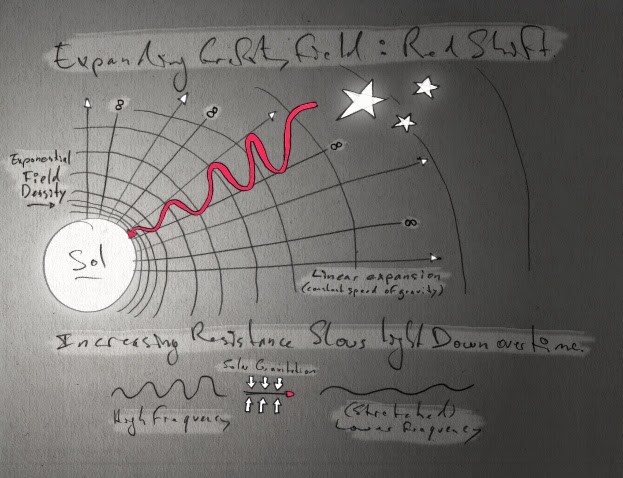
Redshift would define that stars are moving away from us, this freaks me out. Why doesn't anyone say it is the gravity field of our solar system that is expanding over time, and that is what stretches the incommoning lightwaves, causing the redshift effect. A gravity field made up out of emitted gravity particles (8), that move at a constant speed, would expand exponential (x^2) because it originates from a round object (sun), these particles that move away from us cause the Doppler effect. The light shifts happens due to solar gravitation, in the same way that Einstein predicted that starlight is bent by the sun (ref.).

In physics (especially astrophysics), redshift happens when light seen coming from an object is proportionally shifted to appear more red. Here, the term "redder" refers to what happens when visible light is shifted toward the red end of the visible spectrum. More generally, where an observer detects electromagnetic radiation outside the visible spectrum, "redder" amounts to a technical shorthand for "increase in electromagnetic wavelength" — which also implies lower frequency and photon energy in accord with, respectively, the wave and quantum theories of light.
Redshifts are attributable to the Doppler effect, familiar in the changes in the apparent pitches of sirens and frequency of the sound waves emitted by speeding vehicles; an observed redshift due to the Doppler effect occurs whenever a light source moves away from an observer.

I have highlighted the part of the Doppler effect, because a similar 'shift' would happen if you make a sound in the direction of a fan, the harder the fan blows towards the origin of the sound, the further away the speaker appears to be. In a similar way; if the gravity field of our solar system expands over time, than the further away other galaxies seem to be.

On the moon, a combination of gravity and super low atmospheric pressure/density that makes astronouts light on their feet. In the same way an expanding gravity field creates a more dense heliosphere, and like someone posted on a forum (ref.):
Everything we measure is governed by the speed of light...Its a mistake to make that a constant ... It works in envoronment..but the speed of light is constant in a vaccuum....As it passes through any mass it will slow. If it is very far away then it will pass through a lot of mass. hence the time it takes to reach us ... This I think but cannot prove "yet" will effect the Dopler effect ... I can prove however that the further any spectrum of light has to travel then the more it will be slowed by mass.

Also have a look at, Pioneer Anomaly :
The Pioneer anomaly or Pioneer effect is the observed deviation from predicted trajectories and velocities of various unmanned spacecraft visiting the outer solar system, most notably Pioneer 10 and Pioneer 11. Both Pioneer spacecraft are escaping from the solar system, and are slowing down under the influence of the Sun's gravity. Upon very close examination, however, they are slowing down slightly more than expected. The effect can be modeled as a slight additional acceleration towards the Sun. The anomaly has no universally accepted explanation. The explanation may be mundane, such as measurement error, thrust from gas leakage or uneven radiation of heat. However, it is also possible that current physical theory does not correctly explain the behaviour of the craft relative to the sun. (http://en.wikipedia.org/wiki/Pioneer_anomaly)

As mentioned in the article, there are multiple possible explanations, also some in correlation with gravity, and they could also be applicable to cause Redshift, if you take in account that the structure of our solar system is expanding.

A thought experiment: Imagine yourself having a pair of glasses that are constantly collecting dust, and every morning when you put on your glasses, you say: "Hey, the world is getting darker!". Well it might be the same for those who like to think that the stars are moving away from us.

Ring-Orbital?


I 've been wondering how a torus-propellor could generate a Ring-shaped orbital, without being stretched out, this led me to think of 3 possible scenario's:
  1. A sphere that is squeezed down by the upper- and lower proton spheres. It would leave a ring at the outer side were the electron can flow. A membrane type of connection between the ring and the central driving force (torus) would remain.
  2. A torus that is perpendicular possitioned out of the center and who's beam/current is curved around the center of mass.
  3. A torus that keeps it spherish current but that is pushed to the outside and that spins around the center of gravity.
Perhaps all 3 options are possible, perhaps none, anyway I still got a lot of learn about the proton and electron interactions in an atom. btw check out James Maxwell's paper on the nature of Saturn's rings, and the recent discovery of a giant ring around the planet.


Monday, December 6, 2010

Strong Force - Strong Interaction

In particle physics, the strong interaction (Strong Force) is one of the four fundamental interactions of nature, the others being electromagnetism, the weak interaction and gravitation. It is a non-contact force. At atomic scale, it is about 100 times stronger than electromagnetism, which in turn is orders of magnitude stronger than the weak force and gravitation.
The strong interaction is observable in two areas: On the larger scale, it is the force that binds protons and neutrons together to form the nucleus of an atom. On the smaller scale, it is also the force that holds quarks and gluons together to form the proton, the neutron and other particles. (source: wiki)


During particle collisions it is hard to find out if protons and neutrons would all be located in a center nucleus or in a structured disperse setting, as the center of mass for both settings is ... in the middle.