Thursday, April 14, 2011
Tuesday, April 12, 2011
Monday, April 11, 2011
Twisted Torus Rotor
A tryout of a 'twisted torus rotor' setup based on a previous post Synchronous Rotation Motion.


(Sreencast - 20Mb)

Saturday, March 26, 2011
Update mechanical model
Ups and downs, I'm having problems getting the model going with an internal battery system and Remote Control. But this set-up driven by an external power-source gives an indication of how it should be working.
Monday, January 24, 2011
Black Hole - Solar Body - Supernova
In the Birth of a Solar System post I alluded that a star born in an interstellar clouds of dust and gas, could be made out of liquid Super Fluid and BEC instead of Plasma, that eventually would ignite as the surrounding dust disappears. As long as this giant liquid bubble doesn't start 'burning' it is a single black object, maybe this black object may be related to the Black holes that we can observe in our telescopes. I find this article interesting which refers to a Black Hole within a cloud of dust as a generator of stars:
It was speculated that the quasar's host galaxy was hidden behind large amounts of dust, and so the astronomers used a mid-infrared instrument on ESO's Very Large Telescope for the observations. At such wavelengths, dust clouds shine very brightly, and are readily detected. "Observing at these wavelengths would allow us to trace dust that might hide the host galaxy," says Knud Jahnke, who led the observations performed at the VLT. "However, we did not find any. Instead we discovered that an apparently unrelated galaxy in the quasar's immediate neighborhood is producing stars at a frantic rate."
These observations have provided a surprising new take on the system. While no trace of stars is revealed around the black hole, its companion galaxy is extremely rich in bright and very young stars. It is forming stars at a rate equivalent to about 350 Suns per year, one hundred times more than rates for typical galaxies in the local Universe. Source: http://www.eurekalert.org/pub_releases/2009-11/e-bhc113009.php
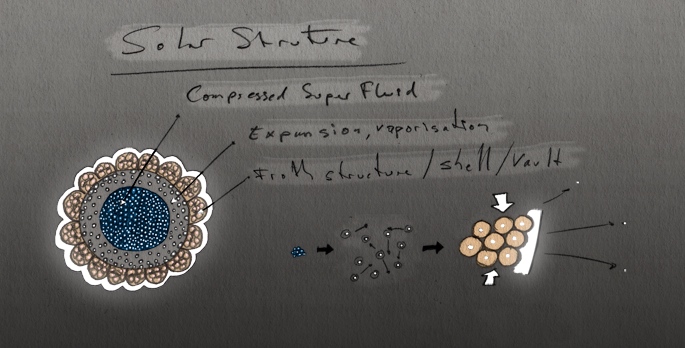
In a basic Solar Structure, the liquid core, with a temperature of zero degrees Kelvin, would vaporize at a constant rate. The heated particles that are set free, form a froth structure that surrounds the complete sphere, like to the foam on a cappuccino. It is also transition area like the plasma membrane of a cell in biology, ll over the surface of this membrane there is a circulation process going on between the exterior and the interior part of the solar body. Sometimes the generated vacuum on the inside sucks 'air' in from the outside through larger gaps than the normal pores, and gravitational forces prevent the bubbles from moving away in bigger chunks than small particle bodies.

I've added a clip and a few pictures of pin-pricked balloons, filled with water and gas, the results are very similar to that of a Supernova.


An interesting resemblance is that of the Sun and a Soap Bubble, their surface (film) seem to have similar liquid behavior: generating 'eddies' and twirly turbulences.

Tuesday, January 18, 2011
Energy Balance: Speed of Light
A body moving through Aether with a to high speed, would place to much pressure on the Aether in front. It would tighten the Aether in front which in turn would prevent the object from drilling it's way through. A body with too little energetic movement, would not have enough force to loosen the Aether in front and can not pass through. The only way of passing through an Aether is by having exact the right constant speed, that is why electromagnetic movement always happens at the speed of light.

An spiraling Torus works just like a worm eating its way through a hard soil. But the most balanced and elegant composition is that of an 8-formation that screws it's way forward. It has the streamlined composition to divide incoming and outgoing Aether in a perfect symmetrical way.

A cool and a bit of a spiritual thing is that the spiraling (8) has the form of the yin-yang symbol. The same symbol was used by Niels Bohr in his 'coat of arms' when he was a member of the prestigious Danish Order of the Elephant. He envisioned the symbol as a striking traditional representation of the principle of complementarity on which he based his views of the fundamental laws of physics (Source: www.numericana.com )


An spiraling Torus works just like a worm eating its way through a hard soil. But the most balanced and elegant composition is that of an 8-formation that screws it's way forward. It has the streamlined composition to divide incoming and outgoing Aether in a perfect symmetrical way.

A cool and a bit of a spiritual thing is that the spiraling (8) has the form of the yin-yang symbol. The same symbol was used by Niels Bohr in his 'coat of arms' when he was a member of the prestigious Danish Order of the Elephant. He envisioned the symbol as a striking traditional representation of the principle of complementarity on which he based his views of the fundamental laws of physics (Source: www.numericana.com )

Sunday, January 16, 2011
Ultra-High-Energy Cosmic Rays

As a short follow up to the previous post where I suggested that the core of a star might be made out of BEC and a Torus like propulsion structure, I would like add that Ultra-high-energy cosmic rays that have energies that are theoretically too high, might be minuscule bundles of BEC that turn into a "bosenova's" when reaching and contacting our atmosphere.
A bosenova or bose supernova is a very small, supernova-like explosion, which can be induced in a Bose–Einstein condensate (BEC) by changing the magnetic field in which the BEC is located, so that the BEC quantum wavefunction's self-interaction becomes attractive. Source: http://en.wikipedia.org/wiki/Bosenova
Most of these OMG particles originate from Super Novae, stars that are splattered apart and who's core is a spiraling Pulsar.

Thursday, January 13, 2011
Birth of a Solar System


I believe that there might be a different process happening that generates stars and makes them burn. Due to the fact that the centers of these new formed clouds are shielded off from all incoming light from surrounding stars, the temperatures can drop to zero degrees Kelvin (0 K), next to the normal temperature of space that is approximately 2.725 Kelvin.
When matter, particularly a fluid such as liquid helium, reaches these low temperatures, it loses all its viscosity, and becomes a superfluid. Superfluids have some impressive and unique properties that distinguish them from other forms of matter. Because superfluids have no internal viscosity, a vortex formed within a superfluid persists forever. A superfluid has zero thermodynamic entropy and infinite thermal conductivity, meaning that no temperature differential can exist between two superfluids or two parts of the same superfluid. A superfluid can also climb up and out of a container in a one-atom-thick layer if the container is not sealed. A conventional molecule embedded within a superfluid can move with full rotational freedom, behaving like a gas. (http://www.wisegeek.com/what-is-a-superfluid.htm)
Another phase of matter that is produced at this temperature is Bose-Einstein condensate, mostly produced from gasses: Bosons' separate electrons tend to occupy the exact same energy level at the same time, which means that the atoms have coalesced into the same exact entity. We can look at this single unit and see one fuzzy point, instead of several separate atoms. Other bosons, like helium-4, can also be forced into a BEC. (http://www.wisegeek.com/what-is-bose-einstein-condensate.htm)
If we put all these factors to gather, I believe that in the center of these clouds, liquid spheres of 'Superfluids' and/or 'BEC' start to form due to the extreme cold. These Spheres start to have an increasing gravity force and start to attract all the remaining parts of the cloud. As over time the dust is cleared a new solar system remains. When the central sphere loses it's protection from all incoming light it starts to heat up and the Superfluid starts to vaporize and the solar body starts to emit light, shine. The fluidness of the core generates an immense Vortex that generates the magnetic field.

Note: For the 'Superfluidness' that rolls against gravity it might be because of it's density, that the substance is pushed forward by the graviton-like emitted particles, atmospheric pressure keeps it grounded. For normal matter the gravity particles (8) can fly through the latices and apply downwards pressure.
Sunday, January 9, 2011
Double Split

For the double split and wave particle duality, I would see the 8-particle as a Bee that zoom's through the Aether, the waves that it makes affects it's path when they are redirected through the second split. This would mean that the parts of the waves travel relatively faster than the light particle, but the speed of the vibration is gradual it precedes, goes along and tails the movement of the particle just like it is for every movement of an object through a medium.
It is a different level of passage of energy, just like a tower build up out of blocks that vibrates when a block at a lower level is pulled out, it surrounds the motion of that piece, the wave and the particle are complementary.

Subscribe to:
Posts (Atom)