Wednesday, November 13, 2013
Chirality External vs. Internal

Tuesday, November 5, 2013
Milling Ants - Koi Fish
An ant-mill is an observed phenomenon in which a group of army ants separated from the main foraging party lose the pheromone track and begin to follow one another, forming a continuously rotating circle. The ants will eventually die of exhaustion. This has been reproduced in laboratories and the behaviour has also been produced in ant colony simulations. This phenomenon is a side effect of the self-organizing structure of ant colonies. Each ant follows the ant in front of it, and this will work until something goes wrong and an ant mill forms.

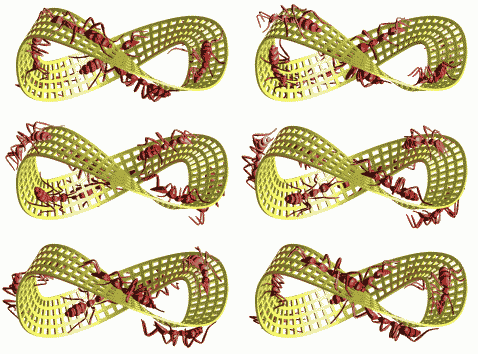
Figure 800 - MC Escher's Moebius Ring with Ants (ref.)
Vortex Loops, Helical Spring and Hair Vortex

Vorticity in shearing plasma layers as strings of identical helix units smoothly joined at their junctions. We present scaling versions of vortex stretching, breaking and reconnection at high Reynolds number breeding chiral vortex loops as in phase slippage events in superfluids.

Here we report the creation of isolated trefoil vortex knots and pairs of linked vortex rings in water using a new method of accelerating specially shaped hydrofoils.

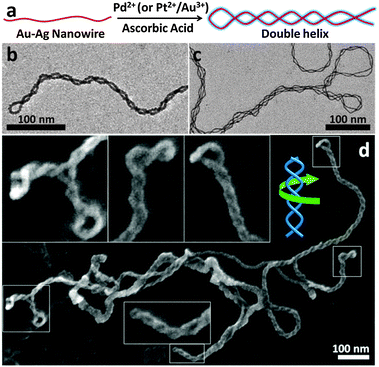
We start by analyzing the origin of chirality in simple systems such as the helical spring and hair vortex.


Laser-induced micro-scale vortex rings have been generated on vaporising tantalum surface, and their reconnection was studied in the presence of shock waves on the nanosecond time scale. A rich spectrum of the ring structures was obtained, some of which have been observed for the first time.

Using the multipulse laser-matter interaction with the Co-coated surface, a one-dimensional high-density vortex-filament array has been created. Increasing the number of pulses, the oscillatory strain field causes the cascade of the shape transformations into structures of increasing topological complexity: vortex filaments into ribbons, into ribbon helicoids and tubular-ribbon helicoids, and then into short ribbon structures with the complex Scherk surface being identified.
Thursday, October 17, 2013
Contact Communication


Long-lived Giant Number Fluctuations in a Swarming Granular Nematic - pdf (734 kb)
--

--

"Emergence of agent swarm migration and vortex formation through inelastic collisions" - pdf (1.6 mb)
--
For a in-depth overview on Collective Motion: http://arxiv.org/abs/1010.5017
Elliptical-design based on a Spring-mechanism
'Springs' and 'Discretization of the problem'
http://www.youtube.com/watch?v=uP7uxiQKGuM (at 2:57 and 4:00)

Rocking Horse pivots and follows an elliptical path,
Same set-up but with a spring,
A foot colliding with the ground follows the same path.

Slinky |ˈsli ng kē|
noun ( Slinky) trademarka toy consisting of a flexible helical spring that can be made to somersault down steps.(In action: https://www.youtube.com/watch?v=ltwxC19s5u8)--Some extra's on Pivoting (sliding)Pivot.pdf (397 kb) - CollisionAntennae.pdf (647 kb)
Friday, September 13, 2013
Self-Propulsion ... Continuous Looped Helical Track

"We propose a model for the self-propulsion of the marine bacterium Synechococcus utilizing a continuous looped helical track analogous to that found in Myxobacteria. In our model cargo-carrying protein motors, driven by proton-motive force, move along a continuous looped helical track."
-

-
"Cells can rotate either in the clockwise (CW) or the counterclockwise (CCW) direction but a rotating cell has never been observed to change the direction of rotation, which, as Willey has pointed out (Willey, 1988), suggests that the “motor” rotates in only one direction and does not switch. This further implies that Synechococcus cells may have a “front” and a “back” end and that the direction of rotation depends on which end of the cell is tethered (Willey, 1988). Unlike flagellated bacteria, no obvious patterns in swimming behavior, such as tumbles or reversals or stops, have been observed but cell shape appears to affect motility: more coccoid cells tend to swim in more looped or spiral paths while rod-shaped cells swim in straight paths (Willey, 1988)."
Non-Flagellar Swimming in Marine Synechococcus - B. Brahamsha - pdf (33 kb)
Characterization of swimming motility in a marine unicellular cyanobacterium - Willey pdf (8.7 Mb)
-

Thursday, September 12, 2013
Monday, September 9, 2013


Subscribe to:
Posts (Atom)