Thursday, January 2, 2014

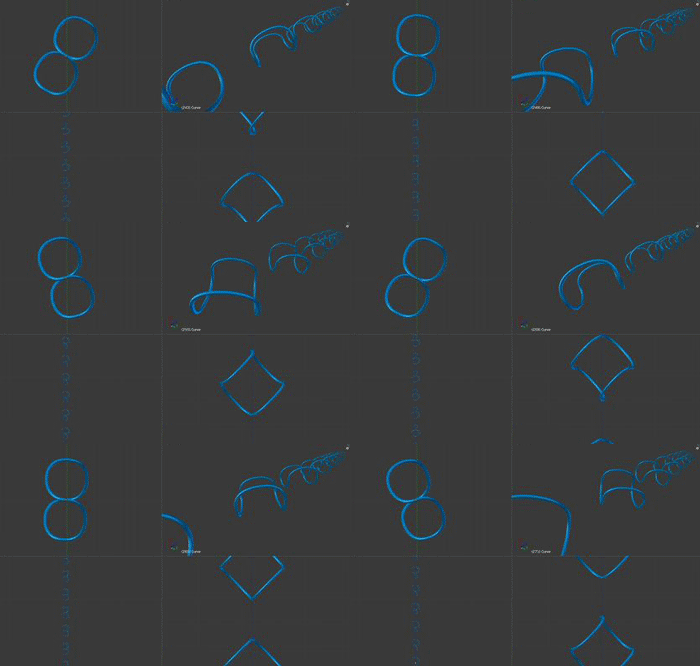
Vibrational projections forming a figure 8 pattern


The patterns generated by the kaleidophone (above) were described in more detail by the mathematician and physicist Jules Lissajous, later in the nineteenth century. He studied the curves created by the combination of two perpendicular vibrations. In order to visualize these curves he designed an instrument consisting of two little mirrors mounted on tuning forks. If the tuning forks sound in a ‘pure’ interval, the resulting image is static and symmetric. If the interval is not ‘pure’, the result is a chaos of lines. Smaller interferences between the two frequencies translate into subtle movements of the generated patterns. (https://en.wikipedia.org/wiki/Lissajous_curve)


Cathode Ray Tube (CRT): If we allow one AC signal to deflect the beam up and down (connect that AC voltage source to the "vertical" deflection plates) and another AC signal to deflect the beam left and right (using the other pair of deflection plates), patterns will be produced on the screen of the CRT indicative of the ratio of these two AC frequencies. These Lissajous figures are a common means of comparative frequency measurement in electronics. (http://www.vias.org/feee/acmeter_03.html)


Flexible Spiral Structure

Here's a link to an interesting TED-talk by biologist Diane Kelly on the anatomy and function of vertebrate penises:


At about 7 min into the talk she explains how a spiral structure is very flexible as it can be Extended and Bend versus a cross-layered structure which is more stiff and less flexible. This adds to the idea that the inner-structure should follow a spiralling flow ...


Z

Thursday, November 21, 2013

Spiraling Figure 8

A short animated-gif of the upwards spiraling figure 8 particle, from the older high res Screencast-movie that I mention in 'About Me' on the side (movie - 40Mb) ... and what this project is about. 


Similar to Professor Oscar Velasco Fuentes' knotted filamentary-vortex:


The final goal is to get this action 'naturally' going within a gas made out of frictionless (ellipsoidal) particles, wherein these of loops automatically would emerge thanks to the right destiny and velocity of the particles that make up the medium. Check the iPhone physics-app 'Liquid' to get an impression of such a gas: https://itunes.apple.com/en/app/liquid-dynamics/id417814216?mt=8. When you adjust the settings you get a medium where continuously semi-vortices pop up (see pic.):

Note: If you haven’t got an iPhone you could check this Java-applet made by Grant Kothttp://grantkot.com/MPM/Liquid.html The iPhone ‘Liquid' App is based on this Java-applet and is roughly the same. In the image below are the settings (upper line-table only blue-green) to get the similar semi-vortices that quickly come an go in and out of existence (note on the iPhone app it’s slightly more intenser and more pronounced), and you need to play with it for a couple of seconds and wait a little to let the gas stabilize ...

... but these semi-vortices are unstable and come and go into existence, so that's why the idea surfaced to use slippery 0val-bodies instead of the 'classic' spherical point-particles; and because these 0val-particles interact in a unique way, with the path that redirects them again along their central-axis, they might a that extra ingredient to the medium, whereby some of these semi-vortices are replaced by vortices that are stable, and take on a steady / solid form within the medium, a bit like how these kids form a closed loop (Ouroboros):

Wednesday, November 13, 2013

Chirality External vs. Internal


In the world of Nano-technology and Self-Propelled Particles (SPP) it is said that Chirality (handedness) is needed for vortex-formations to occur. True, but chirality could also happen due to an external factor, differences in pressure (density fluctuations) within the medium in reference to a perfectly symmetric forward moving SPP.

Tuesday, November 5, 2013

Milling Ants - Koi Fish

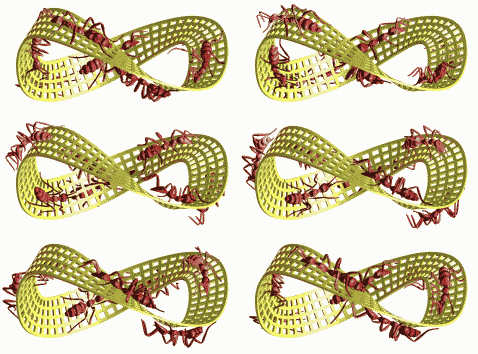
An ant-mill is an observed phenomenon in which a group of army ants separated from the main foraging party lose the pheromone track and begin to follow one another, forming a continuously rotating circle. The ants will eventually die of exhaustion. This has been reproduced in laboratories and the behaviour has also been produced in ant colony simulations. This phenomenon is a side effect of the self-organizing structure of ant colonies. Each ant follows the ant in front of it, and this will work until something goes wrong and an ant mill forms.


Figure 800 - MC Escher's Moebius Ring with Ants (ref.)

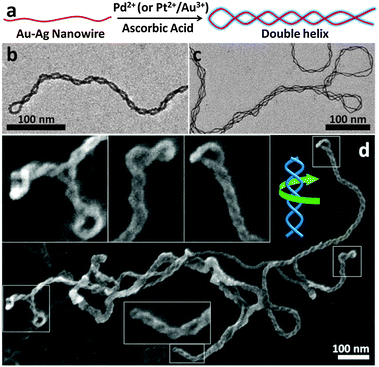
Vortex Loops, Helical Spring and Hair Vortex

Vorticity in shearing plasma layers as strings of identical helix units smoothly joined at their junctions. We present scaling versions of vortex stretching, breaking and reconnection at high Reynolds number breeding chiral vortex loops as in phase slippage events in superfluids. 

Here we report the creation of isolated trefoil vortex knots and pairs of linked vortex rings in water using a new method of accelerating specially shaped hydrofoils.

We start by analyzing the origin of chirality in simple systems such as the helical spring and hair vortex.

 
Laser-induced micro-scale vortex rings have been generated on vaporising tantalum surface, and their reconnection was studied in the presence of shock waves on the nanosecond time scale. A rich spectrum of the ring structures was obtained, some of which have been observed for the first time.

Using the multipulse laser-matter interaction with the Co-coated surface, a one-dimensional high-density vortex-filament array has been created. Increasing the number of pulses, the oscillatory strain field causes the cascade of the shape transformations into structures of increasing topological complexity: vortex filaments into ribbons, into ribbon helicoids and tubular-ribbon helicoids, and then into short ribbon structures with the complex Scherk surface being identified.

Thursday, October 17, 2013

Contact Communication


Long-lived Giant Number Fluctuations in a Swarming Granular Nematic - pdf (734 kb)
--
--
"Emergence of agent swarm migration and vortex formation through inelastic collisions" - pdf (1.6 mb)
--
For a in-depth overview on Collective Motion: http://arxiv.org/abs/1010.5017

Discrete Element Method (DEM)


WOO has got the Ellipsoids going.

Elliptical-design based on a Spring-mechanism

'Springs' and 'Discretization of the problem'
http://www.youtube.com/watch?v=uP7uxiQKGuM (at 2:57 and 4:00)
Rocking Horse pivots and follows an elliptical path,
 Same set-up but with a spring,
A foot colliding with the ground follows the same path. 

Slinky |ˈsli ng kē|
noun ( Slinky) trademarka toy consisting of a flexible helical spring that can be made to somersault down steps.(In action: https://www.youtube.com/watch?v=ltwxC19s5u8)--Some extra's on Pivoting (sliding)Pivot.pdf (397 kb) - CollisionAntennae.pdf (647 kb)